

Blog
How Social Wellness Affects Your Health, Your Biology, and How Long You Live

The Loneliness Epidemic and Why It Matters for Social Wellness and Longevity
Most people understand that diet and exercise affect how long they live. Far fewer understand that their social environment — the quality and frequency of their human connections — has a comparable effect on mortality risk. The research on this is not preliminary. It’s consistent across decades, populations, and study designs, and the numbers are large enough to take seriously.
What makes this harder to act on than dietary advice is that loneliness tends to be invisible from the outside and easy to rationalize from the inside. People with full schedules, active phones, and hundreds of online connections still experience the physiological effects of social isolation — because the biology responds to the quality of in-person connection, not to the volume of digital contact.
This post covers what the evidence actually shows about social wellness and longevity: the biological mechanisms, the mortality data, what Blue Zones populations have in common, and what practical steps move the dial. For people interested in how to reverse aging through lifestyle, social connection belongs in that conversation alongside sleep, nutrition, and physical activity.
The Science of Social Connection: What Happens in the Body
Human beings are wired for social contact in a literal, physiological sense. The nervous system uses the presence of trusted others as a regulatory signal — when you’re with people you feel safe around, your autonomic nervous system downshifts out of threat mode. Heart rate variability improves. Cortisol drops. Immune function becomes less reactive and more balanced.
Conversely, perceived social isolation triggers a threat response. The body can’t easily distinguish between being alone in the woods with no shelter and being alone in a city apartment — both register as elevated risk, and both produce the same cascade of biological changes: elevated cortisol, increased inflammatory signaling, higher blood pressure, and immune dysregulation.
A widely cited review published in PMC analyzed 148 independent prospective studies and found that being socially connected increases the odds of survival by 50% — an effect size that held after controlling for age, initial health status, and lifestyle variables. The authors noted that social connection is an independent protective factor, not simply a proxy for other healthy behaviors.
That 50% survival advantage is larger than the benefit associated with most individual dietary interventions, and comparable in magnitude to the effect of quitting smoking. The challenge is that society has built no equivalent of the smoking ban for loneliness — it remains an under-recognized health variable in most clinical settings.
Loneliness as a Measurable Health Risk: The Mortality Data

Loneliness is not a feeling that sits separate from physical health. It’s a state with measurable biological consequences — elevated inflammatory markers, suppressed immune function, altered HPA axis activity, and changes to cardiovascular regulation that compound over time.
A 2015 meta-analytic review by Holt-Lunstad and colleagues analyzed the mortality effects of social isolation, loneliness, and living alone across decades of prospective research. Social isolation was associated with a 29% increased likelihood of early death, loneliness with a 26% increase, and living alone with a 32% increase. These numbers held across gender, world region, and follow-up duration — meaning they’re not artifacts of a particular culture or study design.
A 2023 systematic review and meta-analysis in PLOS ONE, which analyzed cohort studies through December 2021 from MEDLINE, EMBASE, and PsycINFO, confirmed that social isolation is robustly associated with increased all-cause mortality across populations, with hazard ratios ranging from 1.16 to 3.74 depending on the degree and duration of isolation. The review also noted that social isolation influences health indirectly through behavioral pathways — reduced physical activity, poorer sleep, worse dietary patterns, and lower adherence to medical advice.
For context: the mortality risk associated with social isolation is comparable to smoking 15 cigarettes a day, exceeds the risk associated with obesity, and is roughly double the risk associated with physical inactivity. These comparisons come from the same meta-analytic dataset. They are not meant to minimize the health consequences of smoking or obesity — they’re meant to put loneliness in the category of serious health determinants where it belongs.
The risks are not confined to older adults. While studies of adults over 65 show some of the largest effects, the Holt-Lunstad data showed that social deficits were actually more predictive of death in samples with an average age under 65. Younger adults experiencing social isolation — including those who are professionally successful and digitally well-connected — are carrying a biological cost that most preventive medicine frameworks don’t assess. Foundational biomarker testing can capture inflammation markers like CRP and cortisol that reflect this kind of chronic stress burden.
Why Digital Connection Doesn’t Replace In-Person Contact
The global average for time spent on social media now exceeds two hours daily. Over the same period that screen time has risen, loneliness rates in the United States have roughly doubled. That correlation doesn’t prove causation, but it does suggest that digital communication is not an effective substitute for the kind of connection the body is calibrated to receive.
The distinction the nervous system makes is not between contact and no contact — it’s between co-regulatory, face-to-face contact and everything else. In-person interaction involves a continuous exchange of micro-signals, including facial expressions, tone of voice, physical proximity, touch, and synchronous breathing. These signals run through neural pathways that text messages and video calls simply don’t activate in the same way.
Remote work has removed a layer of incidental social contact that most people didn’t consciously value until it was gone — the brief conversation at the coffee machine, the lunch shared with colleagues, the walk between meetings with a coworker. These interactions were low-intensity and often not perceived as especially meaningful. But they contributed to a baseline of social contact that kept isolation at bay. Their removal, at scale, contributed to a measurable rise in reported loneliness after 2020.
This doesn’t mean technology is harmful — it means that passive digital consumption and social media scrolling don’t register to the nervous system as connection. Phone calls are better than text messages. Video calls are often preferred over phone calls. And in-person contact is in a different category entirely. For people who are managing anxiety and brain health, addressing the quality of in-person social contact is often as relevant as any clinical intervention.
Blue Zones and Longevity: What the World’s Longest-Lived Populations Have in Common
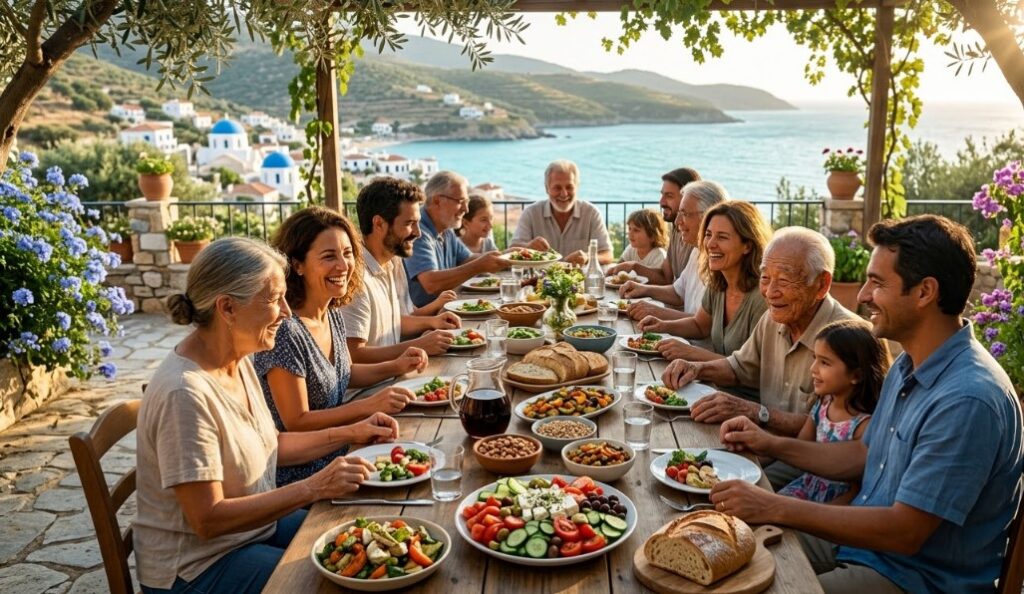
Blue Zones are geographically defined regions with disproportionately high concentrations of centenarians — people who reach 100 in good health. The five confirmed Blue Zones are Okinawa (Japan), Sardinia (Italy), Nicoya (Costa Rica), Ikaria (Greece), and Loma Linda (California). Researchers studying these populations converged on a set of shared lifestyle factors, and strong social integration appears consistently across all five.
A 2018 review Blue Zones described the Okinawan tradition of forming a moai — a committed social group typically formed in childhood and maintained throughout life. One moai documented by researchers had been together for 97 years, with an average member age of 102. These aren’t occasional social gatherings. They’re structured mutual support networks that provide both emotional and practical connections continuously over decades.
In Sardinia, community integration takes a different form — multigenerational households, regular family meals, and a cultural expectation that older members remain integrated into daily life rather than separated into care facilities. This continuous social embedding appears in the data as lower rates of depression, lower cortisol levels, and measurably better cognitive function in old age.
Nicoya’s centenarians report strong family ties and a clear plan de vida — a sense of purpose rooted in their relationships and responsibilities to others. In Loma Linda, the Seventh-day Adventist community structure provides a weekly rhythm through the Sabbath, regular shared activities, and a tight social network built around shared values rather than proximity alone.
What connects all five is that social connection in these populations is structural, not aspirational. It’s built into the daily routine and the physical design of how people live — not something people schedule when they have time. That distinction matters when thinking about how modern adults might reproduce these conditions deliberately.
Mental Health and Social Wellness: Depression, Anxiety, and Dementia Risk
The mental health benefits of social connection are better established than almost any pharmacological intervention for mood. People with larger, more active social networks have consistently lower rates of depression and anxiety, faster recovery from depressive episodes, and lower risk of developing anxiety disorders over time. The effect holds after controlling for baseline mental health — meaning social connection protects against depression, not just the other way around.
Cognitive decline is another area where the data is consistent. Research on preventing Alzheimer’s and dementia increasingly points to social isolation as an independent risk factor for cognitive decline — separate from the effects of physical inactivity, poor diet, or poor sleep. Loneliness appears to accelerate hippocampal atrophy and increase amyloid accumulation over time, two of the hallmark changes in Alzheimer’s disease.
Part of the mechanism involves chronic stress. When loneliness triggers sustained cortisol elevation, it creates conditions that are directly toxic to neurons — particularly in the hippocampus, which is involved in memory formation and spatial navigation. Long-term cortisol exposure reduces hippocampal volume, which is why chronic stress is associated with both depression and early cognitive decline.
The relationship between social isolation and cortisol and the stress response runs in both directions: loneliness elevates cortisol, and elevated cortisol makes it harder to feel comfortable in social situations, reinforcing withdrawal. This feedback loop is one of the reasons loneliness tends to become self-perpetuating rather than self-correcting over time.
The Biological Mechanisms: Cortisol, Inflammation, Immune Function, and Cardiovascular Health
Understanding why social connection affects longevity requires looking at the biological pathways involved. The research here is specific enough to name particular markers and mechanisms rather than generalizing about ‘stress being bad for you.’
Inflammation is one of the clearest pathways. In Brain, Behavior, and Immunity used data from three independent cohorts — the Danish TRIAGE Study (6,144 medical patients), the New Zealand Dunedin Longitudinal Study, and the UK E-Risk Longitudinal Twin Study — and found that social isolation in childhood was longitudinally associated with higher CRP, IL-6, and suPAR levels in adulthood, even after controlling for socioeconomic status, health behaviors, and depression. The childhood-to-adulthood timeline suggests that early social deprivation sets a higher inflammatory baseline that persists into adult life.
A longitudinal study from the English Longitudinal Study of Ageing involving over 8,700 adults confirmed that higher social engagement was associated with lower CRP, fibrinogen, and white blood cell counts, independent of income, physical health, health behaviors, and depression. The study also found that lower loneliness — the subjective experience of insufficient connection — was associated with higher IGF-1, a growth factor linked to tissue repair and cellular maintenance. These associations suggest that both the quantity and quality of social contact have distinct biological effects.
The immune system pathway is also well-characterized. Social isolation activates a conserved transcriptional response to adversity — upregulating inflammatory gene expression and downregulating antiviral defense genes. In practical terms, this means isolated individuals tend to show higher inflammatory activity and weaker antiviral defenses. The body is preparing for physical wounding (which historically followed social exclusion) at the expense of pathogen defense.
Cardiovascular function is directly affected, too. People with lower social integration show higher resting blood pressure, less favorable lipid profiles, and greater arterial stiffness than their socially connected counterparts. Living alone among people with established cardiovascular disease is associated with a 48% higher risk of all-cause mortality — a number from a 2023 meta-analysis of 35 studies covering over 80,000 patients. For anyone already working on improving immune function or managing cardiovascular risk, social wellness is part of the same biological picture.
Practical Strategies to Strengthen Social Wellness
The research points to a few consistent principles that distinguish protective social contact from the kind that leaves people feeling more depleted than connected.
Prioritize depth over frequency. Casual digital contact — brief text exchanges, passive social media scrolling, group chat notifications — does not produce the same nervous system response as extended, face-to-face time with someone you trust. A two-hour dinner with a close friend does more for your biology than 50 Instagram interactions. This doesn’t mean curating your social life to only include deeply intimate relationships — but it does mean making sure your schedule reliably includes some contact of that quality.
Build recurring contact into your routine. Blue Zones populations don’t schedule connection — they structure their lives so that it happens automatically. The Okinawan moai meet daily. Sardinian families share meals. Loma Linda Adventists observe the Sabbath weekly. For most modern adults, the equivalent is a recurring commitment: a weekly breakfast, a standing gym class with a friend, a monthly gathering with a small group. Regular, predictable contact with the same people over time is what builds the kind of relationship that has biological effects.
Join groups organized around shared purpose. Relationships formed around a shared goal, practice, or value tend to be more durable and more satisfying than those formed around proximity alone. Fitness groups, running clubs, book groups, professional networks, and health-focused clubs all provide the context for relationships to develop naturally rather than requiring explicit effort to maintain. The shared activity also provides a reason to keep showing up even when motivation dips.
Get your inflammation markers checked. If you suspect chronic stress or social isolation is affecting your health, measuring it directly is more useful than guessing. CRP, IL-6, and cortisol are all measurable through standard lab panels and provide an objective baseline from which to track whether lifestyle changes — including social ones — are moving your biology in the right direction.
Treat time alone differently from loneliness. These are not the same thing. Solitude chosen freely, in a life with adequate connection, is associated with creativity, recovery, and emotional regulation. Chronic loneliness — the persistent sense that your social needs are not being met — is a health risk. The distinction matters because treating all alone time as a problem leads to social exhaustion, while tolerating loneliness as just introversion leaves the underlying issue unaddressed.
LIVV Cardiff: Social Wellness Built Into the Membership Model
Most wellness facilities are designed for solo use. You go in, do your treatment or workout, and leave. The social dimension — if it exists at all — is incidental rather than intentional. LIVV Cardiff was designed with the opposite logic: the community is part of what the membership delivers, and the physical space and event programming are structured around that.
LIVV Cardiff is a members-only longevity club located at 2027 Newcastle Ave in Cardiff, California. The membership structure — Emerald, Diamond, and Platinum tiers — includes access to workshops, social events, and member gatherings alongside the clinical therapies. The referral-based application process is not gatekeeping for its own sake: it’s a mechanism for maintaining a membership base with shared orientation toward their health, which is what determines whether a community produces the kind of relationships that have biological effects.
On the clinical side, LIVV Cardiff members have access to NAD+ IV therapy for mitochondrial and cellular support, glutathione IV therapy for antioxidant and inflammation management, and IV vitamin drips for immune and energy support. These therapies address some of the same biological markers — CRP, cortisol, mitochondrial function — that social isolation worsens. Pairing clinical support with an environment that actively counters isolation is a more complete approach to longevity than either alone.
LIVV Little Italy, the public-facing clinic at 800 West Ivy St in San Diego, operates Monday through Friday 9 am–5 pm, and offers the same clinical services outside the membership model. Naturopathic medicine in San Diego through LIVV covers not just IV therapy and hormone optimization, but lifestyle medicine — stress assessment, cortisol testing, and protocols that address the full picture of what’s affecting how someone ages.
Social wellness doesn’t show up on a standard blood panel, but its effects do. Tracking your biological age versus chronological age is one way to see whether your lifestyle choices — including the social ones — are producing measurable changes in how your body is aging. People who score older biologically than their calendar age consistently show higher inflammatory burden, and social isolation is one of the factors that contributes to that gap.
Frequently Asked Questions About Social Wellness and Longevity
Does loneliness actually affect physical health, or just mental health?
Both the physical effects are as measurable as anything in a blood panel. Loneliness and social isolation are associated with elevated CRP and IL-6 — inflammatory markers that predict cardiovascular disease, cognitive decline, and early mortality. They’re also associated with higher resting cortisol, reduced immune function, and increased blood pressure over time. The mental and physical pathways are interconnected: chronic social stress activates the HPA axis, which drives cortisol production, which in turn suppresses immune regulation and promotes systemic inflammation. Addressing loneliness is not just a mental health intervention — it’s a biological one.
How is loneliness different from simply preferring time alone?
Loneliness is a mismatch between the social connection you have and the social connection you need — it’s a subjective experience, not an objective measure of how much time you spend alone. Someone who lives alone and has a rich social life may not be lonely at all. Someone who is surrounded by people but lacks meaningful connections often is. The research consistently shows it’s the quality of connection that determines health outcomes, not the volume of social contact. Solitude chosen freely, in a life with adequate connection elsewhere, is associated with creativity and recovery — not with the elevated inflammatory markers linked to chronic loneliness.
Can social wellness really affect how long I live?
Yes, and the effect size is larger than most people expect. A widely cited meta-analysis covering 148 independent prospective studies found that being socially connected increases the odds of survival by 50% — an effect that held after controlling for age, initial health status, and lifestyle factors including diet, exercise, and smoking. For context, the mortality risk associated with social isolation is comparable to smoking 15 cigarettes a day and exceeds the risk associated with obesity. That puts social wellness in the same tier as the dietary and exercise interventions that most people already accept as health priorities.
Why doesn’t digital communication count as a social connection in the same way?
The nervous system regulates itself through in-person co-presence — the continuous exchange of micro-signals that include facial expression, tone of voice, physical proximity, touch, and synchronous breathing. These signals run through neural pathways that text messages, video calls, and social media don’t activate in the same way. Digital communication provides information about people, but it doesn’t produce the autonomic downshift — the drop in cortisol and improvement in heart rate variability — that happens during sustained, face-to-face contact with someone you trust. This is why people can be heavily digitally connected and still show the inflammatory and cortisol profiles associated with social isolation.
What’s the best first step for someone who wants to improve their social wellness?
The most practical starting point is building at least one recurring, face-to-face commitment into your weekly schedule — something that happens on a fixed day with the same people, regardless of how busy the week gets. The research on Blue Zones populations suggests that the health benefit of social connection comes from its regularity and consistency rather than its intensity. Beyond that, if you suspect chronic stress or isolation is affecting your inflammatory markers, measuring it directly is more useful than guessing — CRP, cortisol, and IL-6 are all trackable through a foundational biomarker panel and give you an objective baseline to work from.
Applying for LIVV Cardiff Membership
If you live in the San Diego area and are serious about longevity — the clinical side and the lifestyle side — LIVV Cardiff is worth looking at. The membership is limited, structured around referrals, and designed for people who want their health environment to do more of the work automatically rather than relying on willpower alone.
Founding member applications are currently open with the referral requirement waived. You can review the tiers and apply through the LIVV Cardiff membership page. If you want to start with a clinical consultation before committing to membership, the LIVV team can assess your current baseline — inflammation markers, cortisol, hormone levels — and help you understand what protocols fit your situation.
The research on social wellness and longevity is not ambiguous. Connection is a biological need, and meeting it consistently — with the right people, in a physical space designed for it — is one of the few longevity interventions that requires no prescription and no supplements. It just requires showing up.