

Blog
Hyperbaric Chamber Oxygen Therapy and Anti-Aging
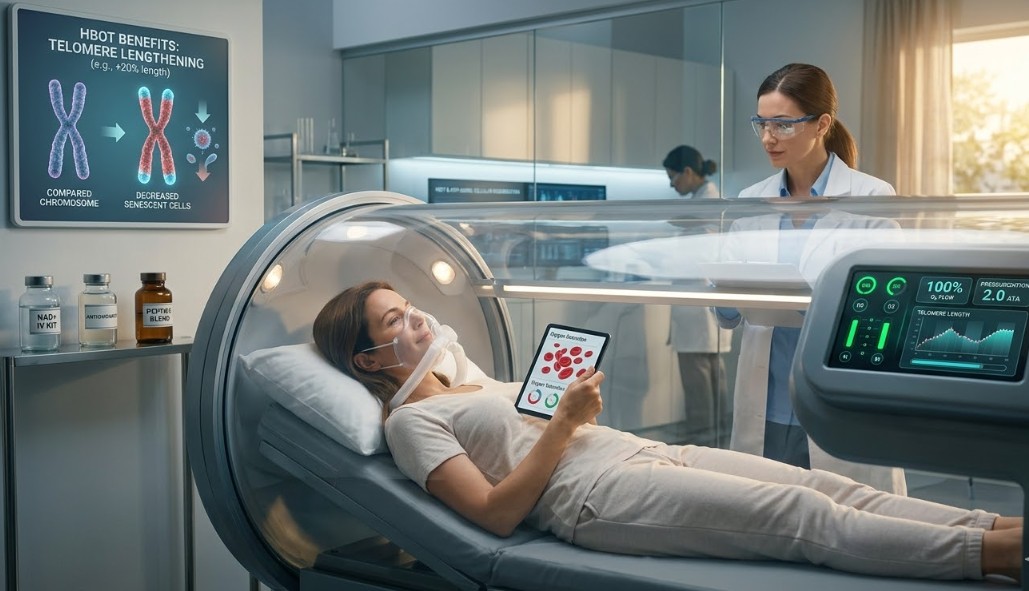
Most anti-aging conversations focus on skincare, diet, or hormones. Fewer people ask what’s happening inside their cells — and that’s exactly where hyperbaric chamber oxygen therapy (HBOT) does its work.
HBOT delivers pure oxygen at higher-than-normal atmospheric pressure. That increased pressure allows oxygen to dissolve directly into blood plasma, reaching tissues that a standard breath of air simply can’t saturate. For anti-aging, this matters because oxygen is the primary fuel for cellular repair, mitochondrial function, and tissue regeneration.
What makes HBOT worth paying attention to isn’t the theory alone — it’s the clinical data. Over the past several years, controlled trials have measured its effects on telomere length, cognitive function, cardiovascular capacity, and cellular senescence. The results are consistent enough that researchers in regenerative medicine have started treating HBOT as a legitimate anti-aging protocol.
If you’ve already looked into anti-aging peptides or other regenerative approaches, HBOT belongs in the same conversation. It targets the upstream cellular processes that determine how quickly your body ages.
What Is Hyperbaric Chamber Oxygen Therapy?
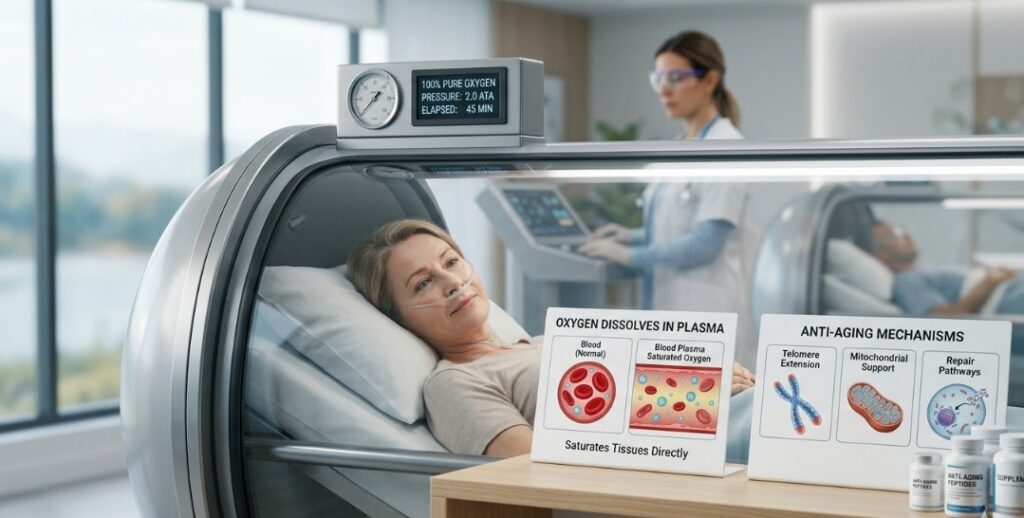
In a standard HBOT session, you lie inside a pressurized chamber — either a single-person unit or a larger multiplace chamber — while breathing 100% pure oxygen at 1.5 to 3 times normal atmospheric pressure. Sessions typically last 60 to 90 minutes.
At that pressure, oxygen dissolves directly into blood plasma rather than relying solely on hemoglobin to carry it. This saturates your tissues with oxygen at concentrations they wouldn’t reach under normal conditions. The cellular response is measurable: repair pathways are activated, inflammatory markers drop, and growth factors are released that promote healing.
From an anti-aging standpoint, this mechanism matters because aging is fundamentally a process of cellular decline. Cells accumulate damage, mitochondria lose efficiency, and telomeres — the protective caps on chromosomes — shorten over time. HBOT addresses several of these processes directly.
A standard course of treatment runs 40 to 60 sessions over several weeks. The anti-aging effects documented in the research are cumulative — they’re built through a full protocol, not a single session. That’s worth knowing before you assess whether HBOT fits your goals.
HBOT and Anti-Aging: What Happens to Your Telomeres
The most discussed finding in HBOT anti-aging research involves telomeres, and the results are hard to look past.
A prospective trial published in the journal Aging found that telomere length increased by over 20% after 60 daily HBOT sessions in adults aged 64 and older. The same study found that senescent cells — cells that stop dividing but refuse to die, releasing inflammatory signals that damage surrounding tissue — decreased by up to 37%.
Shortened telomeres are one of the most reliable biomarkers of biological aging. Most interventions either slow the shortening or have no measurable effect. Actively lengthening them is an outcome researchers have struggled to produce consistently. HBOT produced that result in a controlled prospective trial in a healthy older adult population.
The senescent cell finding carries equal weight. As senescent cells accumulate in tissues, they release what researchers call the senescence-associated secretory phenotype — a cascade of inflammatory signals that degrade surrounding tissue and speed up aging in neighboring cells. Reducing that burden is a primary target in longevity medicine, and HBOT appears to do it without pharmacological intervention.
This is also relevant if you’re already using peptide therapy for cellular repair or growth hormone support. Peptides and HBOT target different mechanisms of the same aging process — pairing them tends to produce stronger outcomes than either does on its own.
Mitochondria, Stem Cells, and How HBOT Anti-Aging Works at the Cellular Level
Oxygen is the primary input in mitochondrial energy production. When cells receive a concentrated dose under pressure, mitochondria respond by producing more ATP and upregulating their own biogenesis — generating more mitochondria, not just making better use of the ones already there.
A review published in Frontiers in Aging confirmed that HBOT induces mitochondrial biogenesis, stem cell proliferation, and angiogenesis — the growth of new blood vessels that improve tissue perfusion. These effects build over a full course of treatment, which is why the protocols used in published research run 40 to 60 sessions rather than a handful of exposures.
Stem cell mobilization is another mechanism worth noting. HBOT increases the number of circulating stem cells by stimulating the bone marrow to release them into the bloodstream. Those cells migrate to sites of damage or inflammation. This is the same pathway used in certain post-injury recovery protocols and is one reason HBOT is being studied for neurodegeneration and tissue repair.
This places HBOT alongside therapies like ozone therapy and exosome therapy — both of which work through systemic regeneration rather than addressing one symptom in isolation.
Hyperbaric Oxygen Therapy for Athletic Performance and Physical Capacity
HBOT’s effects on physical performance extend well beyond acute injury recovery. The data on older adults who’ve never touched a pressurized chamber is particularly striking.
60 HBOT sessions produced measurable improvements in VO2Max and cardiac perfusion in sedentary adults over the age of 64. These are objective cardiovascular and aerobic capacity markers — not self-reported outcomes.
VO2Max is one of the strongest predictors of longevity in the medical literature. Improving it in a sedentary older adult population using a passive therapy — lying inside a pressurized chamber — is a result that stands apart from what most anti-aging protocols produce. For people who can’t exercise intensively due to injury, illness, or age-related decline, HBOT provides a physiological stimulus that mirrors some cellular effects of aerobic training.
Short courses of hyperbaric oxygen may reduce pain and speed return to play after soft tissue musculoskeletal injuries. For anyone managing training loads, that faster recovery window translates directly to fewer disruptions and better long-term consistency.
For a more detailed breakdown of how HBOT applies in an athletic context, LIVV Natural’s guide on hyperbaric chambers for athletic performance covers how sessions are structured for performance and recovery goals.
Brain Function, Memory, and HBOT
Cognitive decline is one of the most feared outcomes of aging — and it’s also one of the areas where HBOT has produced some of the most consistent clinical results.
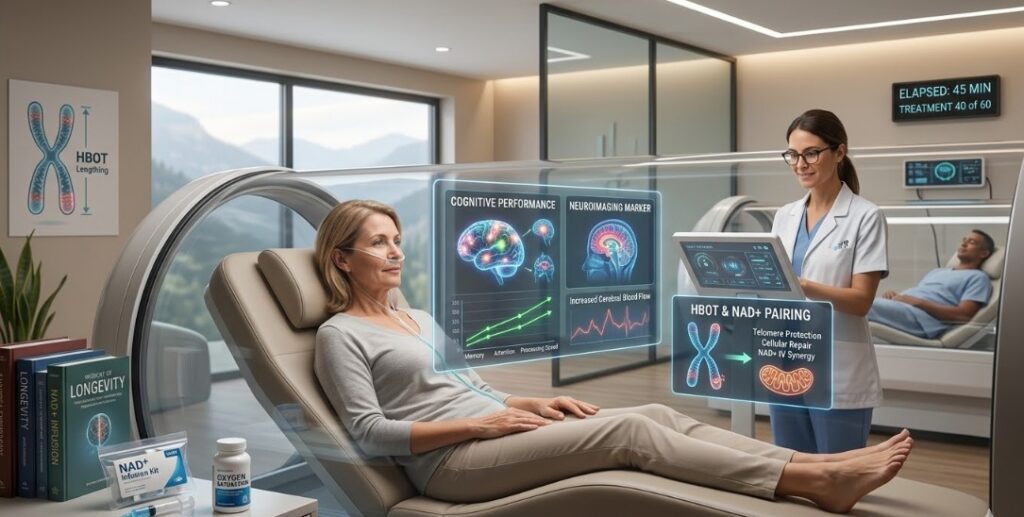
A study published in Frontiers in Neurology examined the effects of 60 daily HBOT sessions on cognition, memory, and brain processing speed. Participants showed measurable improvements in memory, attention, and processing speed, along with neuroimaging markers indicating increased cerebral blood flow. The same cohort also showed improved athletic performance, pointing to system-wide effects rather than isolated ones.
A double-blind randomized controlled trial found that subjects working in a hyperbaric oxygen environment outperformed control subjects on cognitive and motor tasks. This wasn’t a long-term aging study — it measured acute cognitive performance — but it adds to the body of evidence that oxygen saturation directly affects how well the brain functions.
The mechanism connects to what happens in the aging brain: reduced blood flow, decreased oxygen delivery to neurons, and accumulating neuroinflammation. HBOT counteracts all three. The neuroprotective effects aren’t theoretical — they’re showing up on objective neuroimaging and cognitive performance measures in controlled trials.
Pairing HBOT with NAD+ IV therapy — which targets cellular energy production and DNA repair — creates a more thorough approach to protecting brain function over time. The two therapies address different parts of the same underlying process: energy availability, cellular repair, and inflammation control.
Conditions That May Benefit From Hyperbaric Oxygen Therapy
Beyond anti-aging applications, HBOT has FDA-approved uses for wound healing, radiation injury, carbon monoxide poisoning, and decompression sickness. The anti-aging and performance applications covered in this post are used off-label, backed by the trials cited throughout.
Several additional conditions are being studied in relation to HBOT:
Traumatic brain injury and post-concussion syndrome. Multiple trials have looked at HBOT’s effects on neurological recovery after TBI, with promising results in cognitive and functional outcomes.
Long COVID and post-viral fatigue. Early data suggest HBOT may reduce persistent symptoms, including brain fog, fatigue, and cardiopulmonary dysfunction following COVID-19.
Age-related cardiovascular decline. The VO2Max findings referenced above have downstream relevance for heart health, blood pressure, and metabolic function — particularly for adults in their 60s and beyond.
Chronic wound healing and tissue repair. This is one of HBOT’s most established applications. Increased oxygen delivery to hypoxic tissue accelerates healing in wounds that haven’t responded to standard treatment.
If you haven’t already assessed the gap between your chronological and biological age, that’s a useful starting point. It changes how you prioritize which interventions to run first — and where HBOT fits in the sequence.
What a Full HBOT Protocol Looks Like
Most of the anti-aging research used protocols of 40 to 60 sessions, each lasting 60 to 90 minutes, typically administered five days per week. This is a time commitment — it isn’t a single-session fix.
The pressure used in most trials is 2.0 ATA (atmospheres absolute), with subjects breathing 100% oxygen throughout. The protocol is supervised in a clinical setting where pressure is controlled precisely and contraindications are screened before treatment begins.
Contraindications include untreated pneumothorax, certain ear and sinus conditions, and some types of chemotherapy. People with a history of lung disease or claustrophobia should discuss these with their physician first. HBOT is generally well-tolerated, but it is a medical therapy — the dosing and supervision matter.
FAQ:
Does hyperbaric oxygen therapy really help with anti-aging?
Hyperbaric oxygen therapy may support anti-aging by improving oxygen delivery to tissues, promoting cellular repair, supporting mitochondrial function, and influencing biological aging markers such as telomere length and senescent cell burden. It is not a cure for aging, but published research suggests it may help slow or positively affect some of the cellular processes associated with aging when used as part of a full protocol.
Can HBOT lengthen telomeres?
Research has shown that a structured course of HBOT was associated with increased telomere length in certain immune cells in older adults. That finding is one reason HBOT has gained attention in longevity medicine. Still, telomere biology is complex, and results should be viewed as promising clinical data rather than a guarantee that every person will experience the same degree of change.
How many hyperbaric oxygen therapy sessions are needed for anti-aging benefits?
Most of the anti-aging studies that get cited used full protocols of roughly 40 to 60 sessions rather than one or two isolated treatments. A single session may leave you feeling more alert or refreshed, but the cellular and regenerative outcomes discussed in the research are tied to repeated exposure over several weeks. That is why HBOT is generally approached as a cumulative protocol, not a one-time experience.
Is hyperbaric oxygen therapy safe for older adults?
HBOT is generally considered safe when it is performed in a proper clinical setting with medical screening and supervision. Older adults can often use it, but safety depends on individual health history, current medications, lung status, ear and sinus health, and any contraindications. Mild side effects can include ear pressure, temporary fatigue, or sinus discomfort, which is why medical oversight matters.
What does HBOT feel like during a session?
Most people describe HBOT as feeling similar to changes in air pressure during a flight or while driving through mountains. You may notice pressure in your ears as the chamber changes pressure, and you will usually be asked to swallow, yawn, or gently equalize your ears. Aside from that, sessions are typically quiet and restful, with many people simply relaxing throughout the treatment.
Is Hyperbaric Oxygen Therapy the Right Protocol for You?
If you’re looking at HBOT through an anti-aging lens, the most relevant questions are: What are you trying to address, and how does this fit your broader protocol?
For someone focused on slowing biological aging — protecting telomere length, reducing senescent cell burden, keeping cognitive function sharp — the published data support HBOT as one of the more evidence-backed options currently available. The cellular mechanisms are well-documented and the outcomes in older adult populations are consistent across multiple independent trials.
For active individuals managing recovery loads or working to maintain physical capacity into their later decades, the performance data adds another layer of relevance.
At LIVV Natural, HBOT doesn’t sit in isolation. It fits inside a naturopathic medicine framework — looking at how therapies interact at the cellular level, not just what each one does individually. Whether you’re building a full anti-aging protocol or working through a specific concern, this is a therapy worth a real conversation with the medical team.
To find out whether HBOT makes sense for your goals, book a consultation with the LIVV Natural medical team. We’ll review your health history, your current protocols, and the outcomes you’re working toward — and give you a direct answer on whether this fits.