

Blog
How to Live Longer and Healthier: A Practical Guide to Longevity

If you are looking up how to live longer and healthier, you are probably not asking for more birthdays on paper. You are asking for more good years. More energy, better mobility, steadier focus, and a body that still feels usable as you get older. That shift matters. Longevity is not only about lifespan. It is also about healthspan, which means the years you stay physically and mentally functional. LIVV’s current article on this topic already leans in that direction, and that is the right place to start.
What It Really Means to Live Longer and Healthier
Healthy aging is easy to overcomplicate.
In plain English, it means giving yourself the best chance of staying active, capable, and medically stable for as many years as possible. It does not mean chasing perfection, freezing time, or assuming every new longevity trend deserves a place in your routine.
A useful way to think about it is this: lifespan is the length of the movie, while healthspan is how much of that movie you can still enjoy without constant interruption. A lot of people do live longer now than past generations did, but many also spend later years dealing with preventable decline tied to inactivity, poor metabolic health, poor sleep, smoking, excess alcohol, and years of neglected basics. That is why the strongest longevity strategies still start with ordinary habits, not luxury interventions.
Healthspan vs. Lifespan
The distinction matters because it changes what “success” looks like.
Lifespan is the total years lived. Healthspan is the portion of those years lived in relatively good physical and cognitive condition. You can add years without adding much function. You can also improve the odds that your later years are steadier, stronger, and less medically chaotic.
That is why good longevity writing should be less dramatic than most longevity marketing. The real goal is not to “beat aging.” It is to reduce the gap between how long you live and how long you live well. LIVV’s current article frames the topic around that same gap, and it is a better framing than generic anti-aging talk.
The Foundations That Matter Most for Longevity

Most people want to know whether there is one big lever.
There usually is not. There are a few basics that keep showing up because they matter more than almost everything else.
Nutrition
Nutrition for longevity is rarely about one superfood, one supplement, or one strict food rule.
The bigger pattern matters more: enough protein, enough fiber, a mostly whole-food base, fewer ultra-processed foods, and a way of eating that does not keep your blood sugar on a roller coaster all day. Most people do better with repeatable meals than with all-or-nothing discipline. The best diet is the one you can keep doing without resentment.
Protein matters more with age because muscle does not maintain itself forever. Fiber matters because appetite control, gut health, and cardiometabolic health all tend to go better when the basics are covered. Meal regularity matters too. A chaotic food pattern can quietly work against energy, weight stability, recovery, and sleep.
That does not mean everyone needs the same macro split or the same eating window. It means most healthy aging plans work better when meals stop looking random and start looking reliable. Reviews on nutrition and healthy aging keep returning to the same broad conclusion: dietary pattern matters, especially when it helps preserve metabolic health and physical function over time.
Exercise
If there is one habit that keeps earning its place near the top of every longevity conversation, it is movement.
That includes walking, structured cardio, resistance training, mobility work, and basic balance. These are not separate wellness personalities. They are different pieces of the same job. You need muscle. You need aerobic capacity. You need joint range. You need enough stability to avoid turning a simple fall into a life-changing event.
For older adults and middle-aged adults moving in that direction, resistance training matters because muscle loss is not a cosmetic issue. It is a function issue. Strength affects your gait, your balance, your ability to get off the floor, carry groceries, climb stairs, recover from illness, and stay independent. A systematic review and meta-analysis of cohort studies found that people who were more physically active were more likely to age successfully than sedentary adults.
This is also where daily movement still counts. You do not need to treat longevity like an athletic event. A person who walks regularly, lifts two or three times a week, keeps some mobility in the routine, and stays out of the “chair to car to desk to couch” cycle is doing more for healthy aging than someone chasing exotic therapies while barely moving.
Sleep
Sleep is often treated like a side habit. It is closer to a control system.
Poor sleep affects appetite, recovery, mood, training consistency, blood sugar regulation, and cognitive performance. It also changes how resilient you feel day to day. A lot of people try to solve low energy with stimulants, supplements, or IVs while running on too little sleep. That almost always creates a shaky foundation.
The ideal target is not identical for everyone, but adults generally do better when sleep is both long enough and regular enough. A systematic review on sleep and healthy aging found that better sleep was generally associated with a greater likelihood of healthy aging, while the authors also noted that stronger long-term data are still needed.
Practical sleep habits are not glamorous. A steady bedtime helps. So does getting morning light, reducing late-night alcohol, training earlier if late workouts wear you out, and keeping your bedroom dark and cool. None of that sounds futuristic. It still matters.
Stress Load and Recovery
Stress is part of life. Chronic overload is different.
When people say they want longevity, what they often mean is that they do not want to feel worn down all the time. Chronic psychological stress, poor recovery, and a schedule with no real off-switch can spill into sleep, food choices, training consistency, blood pressure, and mood. You do not need a mystical answer here. You need a recovery pattern.
For one person, that may mean walking after dinner and getting off the phone earlier. For another, it may mean strength training three times a week and finally cutting back on the nightly drinks. For someone else, it may mean therapy, boundaries, and fewer false “urgent” tasks.
Recovery is not separate from longevity. It is one of the conditions that makes the rest of your habits stick.
Intermittent Fasting: Where It May Fit
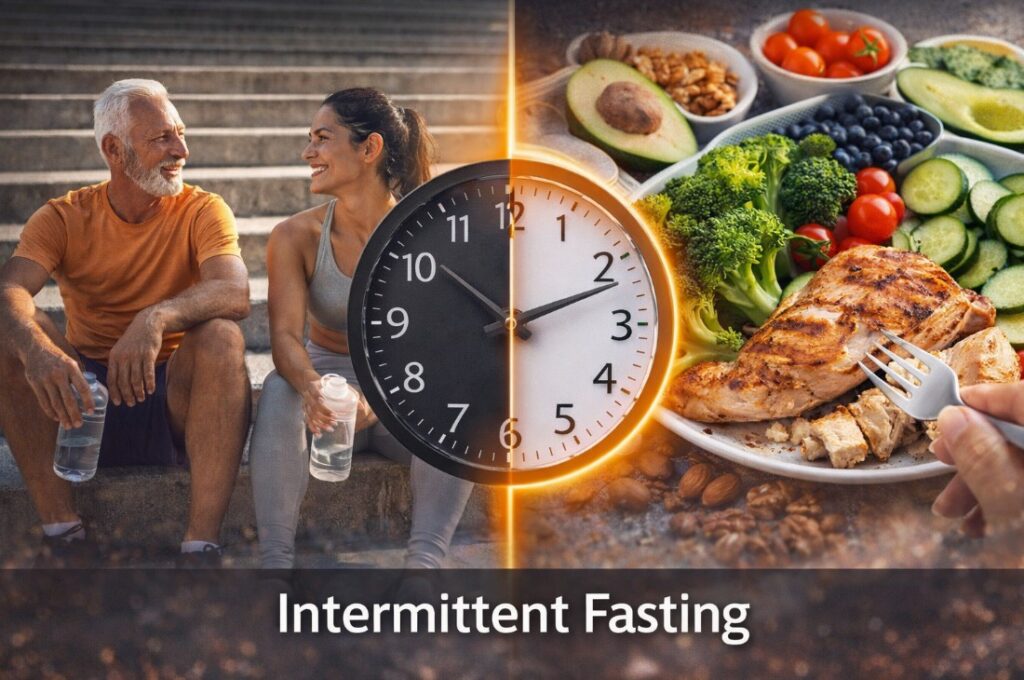
Intermittent fasting gets pulled into longevity conversations quickly, usually before the basics are sorted out.
There is some reason for the interest. Fasting has been studied for metabolic health, cellular stress responses, and possible effects related to healthy aging. A large review in Nature Aging described intermittent and periodic fasting as areas of active interest, with promising biology and some human metabolic findings, while also making it clear that clinical outcomes and ideal protocols are still being worked out.
That is the balanced version.
Fasting is a tool. It is not a shortcut. Some people do well with a narrower eating window because it helps with appetite control, late-night snacking, or energy stability. Other people do worse. They get irritable, under-eat protein, train badly, sleep worse, or turn food timing into another source of stress.
It may not be a good fit for everyone. People with a history of disordered eating, those who are pregnant, those on certain medications, very lean individuals, or people whose work and training schedule already strain recovery should be more careful here.
The real question is not “Is fasting good?” It is “Does this food pattern make my life and my health markers better without creating new problems?”
NAD+ and Why It Keeps Coming Up in Longevity
NAD+ shows up in almost every modern longevity conversation because it plays a role in cellular energy metabolism and other processes linked to aging biology.
That part is real. The harder part is staying calm once the marketing starts.
NAD+ is biologically interesting. That does not mean every NAD-related product or therapy has proven long-term longevity effects in humans. LIVV has a current NAD+ IV therapy page and related NAD content, so it makes sense for the topic to appear naturally in a broader longevity guide.
A grounded way to frame it is this: NAD+ belongs in the category of emerging or still-developing longevity interest, not the category of “the basics no longer matter.” If your sleep is poor, your movement is inconsistent, your nutrition is random, and your stress load is high, NAD+ is not likely to clean up the whole picture by itself.
That does not make it irrelevant. It just puts it in the right order.
Peptide Therapy in a Longevity Context
Peptide therapy tends to get discussed too broadly, as if “peptides” were one thing.
They are not. Peptides are a category, and what they do depends on the specific compound, dose, indication, route, and medical context. That means it is better to speak about peptide therapy as a medically guided category than as a blanket longevity fix.
LIVV currently offers a peptide therapy page and a wide range of peptide-related content, which tells you this is part of the brand’s wider wellness model. At the same time, the page itself spans many goals and products, which is exactly why general claims should stay restrained.
For some people, peptide therapy may fit a broader plan around recovery, body composition, sleep, or other wellness goals. For others, it may not belong in the plan at all. The key point is that it should be discussed by compound and by goal, not as a vague promise.
Hormesis: Small Stressors, Better Adaptation
Hormesis sounds abstract until you put it into normal language.
It means a small, manageable stressor can make the body adapt in a useful way. Exercise is the clearest example. You challenge the system, then recover, and the body gets a bit better at handling that load. Sauna and cold exposure are often discussed in the same lane, though they should not be treated like mandatory longevity rituals.
This is where people often go too far. More is not always better. More cold is not always better. More heat is not always better. More fasting is not always better. A stressor only helps when the dose and the recovery are sensible.
For some people, sauna can be a pleasant recovery habit. For others, walking consistently and lifting weights is a far better use of attention. Longevity habits only work when they fit the actual person doing them.
What Has the Strongest Evidence?
This is the section many longevity articles avoid because it is less exciting than a new therapy menu.
The strongest evidence still sits with the basics:
- regular physical activity
- resistance training
- decent sleep
- a mostly whole-food eating pattern
- healthy body composition
- avoiding smoking
- moderating alcohol
- managing blood pressure, glucose, and other risk factors early rather than late
That does not mean advanced therapies have no place. It means they should be layered on top of a strong base, not used as a substitute for one. If the basics are weak, the rest of the plan usually gets expensive before it gets effective. The current LIVV longevity article makes a version of this point already, and it is one worth keeping.
A More Realistic Way to Build a Longevity Plan
Most readers do not need twelve new habits by Monday.
They need a better order of operations.
Start with the habits that affect the most systems at once. That usually means sleep schedule, daily movement, resistance training, protein intake, fiber intake, alcohol intake, and stress load. Then look at what still feels off. Energy? Recovery? Body composition? Brain fog? Lab markers? At that point, the conversation about more advanced options becomes more useful.
This is also where a doctor-guided plan can be worth the time. Not because every person needs a long list of treatments, but because some people do better when their health questions are organized into an actual plan instead of a stack of disconnected trends.
Who May Want a Doctor-Guided Longevity Plan?
Some people do fine with a straightforward habit reset on their own.
Others usually benefit from more structure:
- people with demanding schedules who know their habits are sliding
- people noticing slower recovery, lower energy, or worse body composition over time
- people who want a preventive approach before things get more complicated
- people who feel stuck between “I should just try harder” and “I probably need a better plan”
At LIVV, that doctor-led framing is part of the brand’s current positioning. The site describes LIVV as a naturopathic medical clinic and wellness center, and the medical team page presents clinicians across naturopathic and medical disciplines.
That kind of setting makes more sense for longevity than a one-size-fits-all script. Good care should help you sort what actually deserves attention, what can wait, and what does not belong in the plan at all.
Longevity at LIVV Natural
Within LIVV’s current site, longevity is tied to a wider wellness model rather than a single treatment page. The brand’s existing longevity article, its NAD+ IV therapy page, its peptide therapy page, its medical team, and its about page all point toward that broader approach.
That is the right lane for this topic.
A good longevity plan should feel measured. You look at habits first. Then risk factors. Then recovery. Then, whether more advanced options make sense for that specific person, in that specific season of life.
FAQs
What is the difference between lifespan and healthspan?
Lifespan is how long you live, while healthspan is how long you stay physically and mentally functional during those years. In practical terms, most people are not just looking for more years on paper. They want more good years with better mobility, steadier energy, clearer thinking, and less preventable decline.
What habits have the strongest evidence for longevity?
The strongest evidence still points to the basics: regular exercise, resistance training, decent sleep, a mostly whole-food eating pattern, healthy body composition, not smoking, moderating alcohol, and managing blood pressure, glucose, and other risk factors early. Advanced therapies may have a place for some people, but they work best when they are layered on top of a strong base rather than used as a substitute for one. The broader evidence base on healthy aging and longevity medicine supports this same order of priorities.
Why does exercise matter so much for healthy aging?
Exercise matters because it supports multiple parts of longevity at once: muscle mass, aerobic fitness, balance, joint function, recovery, and independence. Resistance training becomes especially important with age because muscle loss is not just cosmetic. It affects gait, stability, strength, and the ability to stay functional in everyday life.
How important is sleep for longevity?
Sleep is one of the core control systems behind healthy aging because it affects appetite, recovery, mood, blood sugar regulation, cognitive performance, and training consistency. A lot of people look for a shortcut to better energy while ignoring poor sleep, but that usually creates a weak foundation for every other part of a longevity plan. Reviews on sleep and healthy aging likewise associate better sleep with better aging outcomes, although long-term data are still being refined.
Does intermittent fasting help with longevity?
Intermittent fasting may help some people, but it is better viewed as a tool than as a shortcut. It has been studied for metabolic health and cellular stress responses, and some people do well with it when it improves appetite control or meal structure. Others do worse if it disrupts sleep, recovery, protein intake, or overall consistency. The better question is whether it improves your real health markers without creating new problems. Human research supports active interest in fasting for metabolic and aging-related outcomes, but ideal protocols and long-term clinical effects are still being worked out.
Is NAD+ one of the most important anti-aging treatments?
NAD+ is biologically interesting because it plays a role in cellular energy metabolism and other processes linked to aging biology, which is why it appears so often in longevity conversations. But biologic relevance is not the same as proven long-term longevity benefit in humans. In a practical plan, NAD+ belongs in the category of emerging interest, not the category of fundamentals that outrank sleep, movement, food quality, and metabolic health. Current reviews support NAD+ as an important aging-related pathway, while also showing that clinical translation is still developing.
Can peptide therapy help with longevity?
Potentially, but it should not be discussed as one blanket solution. Peptides are a broad category, and their role depends on the specific compound, dose, route, goal, and medical context. For some people, peptide therapy may fit into a broader plan around recovery, body composition, or sleep. For others, it may not belong in the plan at all. The useful way to think about peptide therapy is by compound and by goal, not as a vague promise.
Can advanced longevity treatments replace the basics?
No. That is one of the clearest points in our blog. Advanced options may be worth considering for the right person, but they should be layered on top of a strong base, not used to cover for weak habits. If sleep is poor, movement is inconsistent, nutrition is random, and recovery is neglected, even expensive interventions usually lose a lot of their value.
Who may benefit from a doctor-guided longevity plan?
A doctor-guided plan may make the most sense for people with demanding schedules, people noticing lower energy or slower recovery over time, people who want a preventive approach before problems become bigger, or people who feel stuck between trying harder and needing a more structured plan. In that context, guidance is less about adding endless treatments and more about putting habits, risk factors, labs, and recovery into the right order.
The Better Question to Ask
A lot of people ask, “How do I live longer?”
A better question is, “How do I keep more of my later years usable?”
That shift changes everything. It moves you away from miracle thinking and toward habits that hold up. It also makes room for advanced therapies without pretending they outrank sleep, strength, food quality, and metabolic health.
If you want help building a more realistic, healthy aging plan, LIVV’s current site points readers toward its clinical team and consultation pathway rather than treating longevity like a one-product answer. That is a better way to approach the topic.