

Blog
PT‑141 Peptide: The ‘Magic Shot’ for a Thriving Love Life

Feeling disconnected from your partner can be heartbreaking. Many men and women struggle with a fading spark and blame themselves, but it is often a sign of underlying hormonal and lifestyle imbalances.
Thankfully, modern science offers new options that go beyond pills and band‑aids.
One of the most exciting breakthroughs is a tiny peptide called PT‑141 — a medicine approved to treat women with hypoactive sexual desire disorder and used off‑label to support erectile function in men.
In this guide, you’ll learn what the PT‑141 peptide is, how it works in the body, and why it could transform your intimate life.
We’ll break down the science in simple language, explore benefits and risks, compare it with traditional erectile dysfunction drugs, and answer the most common questions people ask online.
The goal is to empower you with knowledge so you can make informed choices and reignite your passion.
In This Article
- Understanding Low Libido
- What Is PT‑141?
- How PT‑141 Works in the Body
- Benefits of PT‑141 for Women
- Benefits of PT‑141 for Men
- PT‑141 vs PDE‑5 Inhibitors
- Administration and Dosage Guidelines
- Side Effects and Safety Considerations
- Who Should Avoid PT‑141
- Complementary Approaches for Boosting Libido
- Combining PT‑141 With Other Therapies
- The LIVV Natural Approach to Sexual Wellness
- Conclusion
Understanding Low Libido
Libido is a person’s natural desire for sexual intimacy. Fluctuations are normal over a lifetime, but persistent low drive can feel frustrating and confusing.
Researchers note that low sexual desire is common; about 8 % of premenopausal women in the United States are affected by hypoactive sexual desire disorder.
Men experience issues too, often related to stress, hormones, circulation, or psychological factors.
Sexual health is tied closely to overall well‑being. A low libido can signal physical concerns like hormonal imbalance, thyroid dysfunction, or cardiovascular disease, but it can also arise from emotional stress and relationship dynamics.
Addressing the root causes can improve mood, sleep, and self‑confidence, not just intimacy.
Why a Healthy Libido Matters
Sexual desire is more than just pleasure. It reflects hormonal balance, cardiovascular health, and psychological resilience.
When desire fades, many people feel shame or worry; relationships can suffer from miscommunication and resentment.
Taking steps to support your libido may lead to improved energy, stronger connections, and better mental health.
Understanding why desire changes helps you choose the right approach. Lifestyle factors such as diet, sleep, exercise, and stress management can influence hormones like testosterone and estrogen.
Chronic stress raises cortisol, which suppresses sex hormones and leaves you feeling tired and disconnected.
Emotional trauma or anxiety can also dampen desire. A holistic strategy should address both body and mind.
What Is PT‑141?
PT‑141 (generic name bremelanotide) is a synthetic heptapeptide derived from the hormone α‑melanocyte‑stimulating hormone.
Scientists initially developed it to darken skin, but they soon noticed it increased sexual arousal. Bremelanotide acts as a melanocortin receptor agonist, meaning it activates receptors such as MC1R, MC3R, and MC4R.
These receptors are found in the brain and regulate appetite, energy balance, and sexual behaviour.
In 2019, the U.S. Food and Drug Administration (FDA) approved a prefilled injection pen called Vyleesi (bremelanotide) for the treatment of acquired, generalized hypoactive sexual desire disorder in premenopausal women.
While only approved for women, doctors sometimes prescribe PT‑141 off‑label to men with erectile dysfunction or low libido.
Unlike pills such as sildenafil (Viagra) that mainly increase blood flow to the penis, PT‑141 works centrally by stimulating brain pathways involved in sexual desire.
How Does PT‑141 Differ From PDE‑5 Inhibitors?
Traditional drugs for erectile dysfunction — such as sildenafil, tadalafil, and vardenafil — belong to a class called PDE‑5 inhibitors.
They work by relaxing blood vessels in the penis so blood flows in more easily when a man is already sexually aroused.
PT‑141 works upstream in the brain. It activates melanocortin receptors and triggers the release of dopamine and nitric oxide, which then send signals to the sexual centres in the brain and spinal cord.
As a result, PT‑141 can boost desire in both genders and cause erections in men even without external stimulation.
Because PT‑141 targets the brain’s arousal centres, it may help people who do not respond well to PDE‑5 inhibitors.
It is also the first drug approved to treat female sexual desire disorder since Addyi (flibanserin). Later in this article, we compare PT‑141 and PDE‑5 drugs side by side.
How PT‑141 Works in the Body
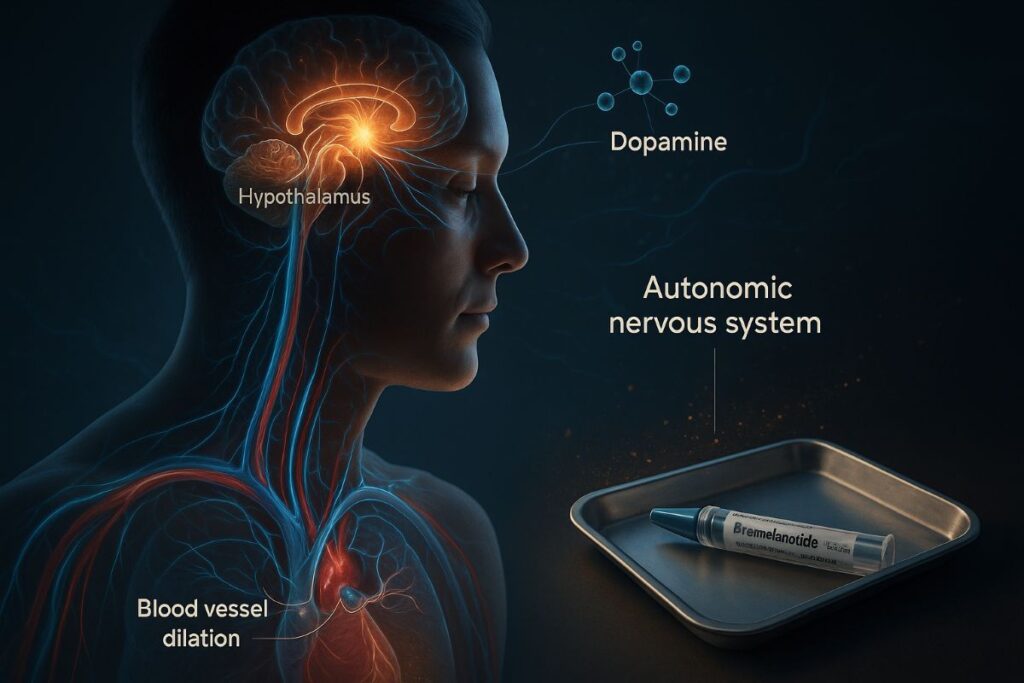
PT‑141 is a potent agonist of several melanocortin receptors. Studies show that it binds most strongly to the MC1R and MC4R receptors and also activates MC3R and MC5R.
These receptors are concentrated in the hypothalamus, the brain’s control centre for hormones and behaviour.
Activation of MC4R triggers the release of dopamine in the medial preoptic area, a region that controls sexual motivation.
Dopamine release increases feelings of desire and initiates the cascade leading to arousal.
PT‑141 also influences the autonomic nervous system.
Animal and human studies indicate that it prompts the release of nitric oxide, a molecule that relaxes smooth muscle in blood vessels.
This relaxation increases blood flow to the sexual organs and contributes to erection and genital sensitivity.
Importantly, because PT‑141 does not act on the cardiovascular system directly, it does not typically cause dangerous drops in blood pressure like some other medications.
Pharmacokinetics
PT‑141 is usually administered as a subcutaneous injection. The recommended dose for women in clinical trials was 1.75 mg injected into the abdomen or thigh at least 45 minutes before anticipated sexual activity.
DrugBank data show that bremelanotide reaches peak concentration within one hour (Tₘₐₓ of 0.5–1 hour) and is 100 % bioavailable.
It has a mean half‑life of around 2.7 hours and is eliminated mostly in the urine and feces.
The injection should not be used more than once in 24 hours or more than eight times per month due to the risk of transient blood pressure increases and nausea.
An intranasal formulation has been studied in men and produces rapid effects within 15–30 minutes, but it is not commercially available.
Benefits of PT‑141 for Women
PT‑141 is currently approved for women with acquired, generalized hypoactive sexual desire disorder.
In two placebo‑controlled phase 3 trials, women who received bremelanotide injections reported higher levels of sexual desire and more satisfying sexual experiences compared with placebo.
The median improvement in satisfying sexual events was 0.5–1.0 events per month from a baseline of 2–3 events.
Participants also reported reduced distress related to low sexual desire and improved orgasm frequency.
Women took their dose about 45 minutes before sexual activity; many described a warm flush followed by increased desire within an hour.
The FDA emphasised that using up to eight doses per month is safe for otherwise healthy women and that the benefits outweigh the risks when used as directed.
Emotional and Relationship Improvements
Low libido can strain relationships and self‑esteem. In clinical studies, women treated with PT‑141 not only experienced increased desire but also reported greater satisfaction with their relationships.
When desire returned, couples found it easier to communicate and enjoy intimacy. Researchers note that improved sexual health often enhances mood, reduces anxiety, and fosters self‑confidence.
Because PT‑141 works on the brain’s reward pathways, some women described feeling more connected to their partners even outside the bedroom.
This psychological benefit underscores the holistic nature of sexual health. Therapy or counselling alongside PT‑141 may amplify these gains.
Benefits of PT‑141 for Men
Although not yet FDA‑approved for men, PT‑141 has been studied for erectile dysfunction and low libido.
Early trials using intranasal PT‑141 showed that doses of 7.5 mg or higher led to statistically significant erectile responses within 30 minutes.
About 34 % of men reported improved erectile function compared with 9 % receiving a placebo.
These trials included men who did not respond to PDE‑5 inhibitors. PT‑141 induced erections without the need for external stimulation because it activates the brain’s sexual response centres.
Combining PT‑141 with sildenafil produced even stronger and longer erections; one study reported that the combination increased erection duration by fivefold compared with sildenafil alone.
Psychological Benefits for Men
Erectile dysfunction often harms a man’s self‑image. The ability to achieve an erection can restore confidence and reduce anxiety.
Men in PT‑141 studies reported improved self‑confidence and greater satisfaction with their sex lives. Because PT‑141 acts on dopamine pathways, some users also described elevated mood and motivation outside the bedroom.
Men considering PT‑141 should work closely with a healthcare provider. Off‑label use requires understanding the risks and determining whether underlying health issues contribute to sexual dysfunction.
Lifestyle changes like weight management, exercise, and stress reduction should accompany any therapy.
PT‑141 vs PDE‑5 Inhibitors
The table below compares PT‑141 with popular PDE‑5 inhibitors like sildenafil (Viagra) and tadalafil (Cialis). Understanding these differences helps you and your clinician choose the right option.
| Factor | PT-141 | PDE-5 inhibitors |
|---|---|---|
| Primary action | Stimulates melanocortin receptors in the brain; boosts dopamine and nitric oxide | Blocks the PDE-5 enzyme to increase blood flow to the penis |
| Effect on desire | Increases sexual desire and arousal in both women and men | Does not enhance desire; works only when there is sexual stimulation |
| Onset of action | 45 min for injection; 15–30 min for intranasal form | 30–60 min depending on the drug |
| Duration | Half-life ~2.7 hours; effects may last up to 8 hours | Varies: sildenafil 4 h, tadalafil up to 36 h |
| Use in women | FDA-approved for hypoactive sexual desire disorder | Not approved for women |
| Need for sexual stimulus | Not required; can provoke arousal on its own | Required; works only during sexual stimulation |
| Common side effects | Nausea, flushing, injection site reactions, headache, transient blood pressure increase | Headache, flushing, nasal congestion, vision changes |
| Contraindications | Uncontrolled hypertension, cardiovascular disease, pregnancy, and breastfeeding | Recent nitrate use, severe heart disease, hypotension |
| Route | Subcutaneous injection or intranasal spray | Oral pill |
Administration and Dosage Guidelines
PT‑141 is delivered via a small injection under the skin. For women, the approved dose is 1.75 mg injected into the abdomen or thigh at least 45 minutes before anticipated intimacy.
Men using PT‑141 off‑label often start with 2 mg and adjust based on response and side effects. Always consult a medical provider for guidance.
Key dosing rules include:
- Maximum frequency: Do not exceed one dose in 24 hours or eight doses per month. More frequent use increases the risk of nausea and blood pressure spikes.
- Injection technique: Clean the skin with alcohol, pinch a fold of fat, insert the needle at a 45‑degree angle, and inject slowly. Rotate injection sites to avoid irritation.
- Onset and timing: Most users feel effects within 45 minutes, with peak response at about 1–2 hours. Plan accordingly so intimacy isn’t rushed.
- Storage: Keep PT‑141 refrigerated until use. Do not freeze.
- Avoid concurrent alcohol or multiple stimulants: Combining PT‑141 with alcohol or other stimulants may worsen nausea.
Some clinics offer PT‑141 as part of a nasal spray or compounded nasal spray. While intranasal delivery can work faster, dosage and purity vary by supplier. Always verify quality and work with an experienced practitioner.
Side Effects and Safety Considerations
Most users tolerate PT‑141 well, but side effects can occur. In phase 3 trials, up to 40 % of women experienced nausea compared with 1 % on placebo.
About 13 % of participants discontinued treatment due to nausea. Many people find that eating a light snack and staying hydrated helps ease discomfort.
Other commonly reported side effects include flushing, injection site reactions, headache, and vomiting.
The Mayo Clinic notes that injection site reactions may present as redness, swelling, or a warm feeling.
Rare side effects include dizziness, darkened urine, blurred vision, and changes in skin pigmentation.
The FDA review warns that PT‑141 can temporarily raise systolic and diastolic blood pressure by around 3 mmHg and lower heart rate by about 2 beats per minute.
These changes usually return to baseline within 12 hours, but people with uncontrolled hypertension or heart disease should avoid PT‑141.
Hyperpigmentation and Skin Changes
Some users experience focal hyperpigmentation of the face, gums, or breasts. This occurs in about 1 % of users and appears more often in people with darker skin tones.
In half of the cases, the pigmentation fades after stopping treatment. Because PT‑141 can stimulate melanocyte receptors, people prone to moles or melanoma should discuss risks with their doctor.
Pregnancy and Breastfeeding
The safety of PT‑141 in pregnancy has not been established. The FDA recommends using effective contraception and stopping PT‑141 if pregnancy is suspected. Breastfeeding mothers should also avoid PT‑141 until more research is available.
Drug Interactions
Clinical data suggest that bremelanotide does not interact with alcohol, but combining it with other medications that affect blood pressure or heart rate could be risky. Always tell your healthcare provider about all medications and supplements you take.
Who Should Avoid PT‑141
Because PT‑141 affects blood pressure and heart rate, certain people should avoid it or use it with caution. These include:
- Individuals with uncontrolled high blood pressure or a history of cardiovascular disease.
- Pregnant or breastfeeding women.
- People with liver disease; there was one possible case of drug‑induced liver injury after long‑term use.
- Those prone to hyperpigmentation or skin cancers.
- Children and adolescents.
- Anyone taking medications that lower blood pressure or heart rate.
Always consult a healthcare professional before starting any new therapy. Self‑injecting peptides without guidance increases the risk of contamination and incorrect dosing.
Complementary Approaches for Boosting Libido
PT‑141 works best when combined with lifestyle and holistic strategies. Simple changes can support hormone production and circulation, which may enhance the peptide’s effects:
- Nutrition: Focus on whole foods, lean proteins, healthy fats, and plenty of fruits and vegetables. Nutritional deficiencies, especially in zinc, vitamin D, and B vitamins, can depress sex hormone production.
- Exercise: Regular movement improves blood flow and releases endorphins. Strength training and high‑intensity intervals boost testosterone and growth hormone.
- Sleep: Aim for 7–9 hours per night. Poor sleep lowers testosterone and increases cortisol, which impairs libido.
- Stress management: Yoga, meditation, deep breathing, and counselling help reduce cortisol and calm the nervous system. Lowering stress may restore desire naturally.
- Relationship support: Communication, intimacy exercises, and therapy can rebuild trust and excitement. Addressing emotional blocks is just as important as addressing biology.
For detailed guidance on lifestyle factors, see our post on boosting your libido naturally. It discusses signs of low libido, physical and emotional causes, and natural strategies to restore balance.
Combining PT‑141 With Other Therapies
Many people ask whether PT‑141 can be used alongside other therapies. The answer depends on individual health and goals:
- PDE‑5 inhibitors: Research shows that pairing PT‑141 with sildenafil or tadalafil can produce stronger erections and longer duration. A combination may help men who only partially respond to pills. Doses should be adjusted to minimize side effects.
- Kisspeptin: This peptide stimulates the hypothalamic‑pituitary‑gonadal axis, boosting testosterone and fertility. Combining kisspeptin with PT‑141 may enhance sexual drive and hormonal balance. Our article on kisspeptin for fertility and hormone support explores how kisspeptin works and who may benefit.
- Testosterone therapy: Men with clinically low testosterone might consider replacement therapy under medical supervision. Adequate testosterone levels are necessary for PT‑141 to work optimally.
- Nutraceuticals: Supplements like ginseng, maca, and L‑arginine may support libido by improving circulation and hormone production. They are not replacements for medical treatment but can complement therapy.
Discuss combination strategies with a qualified provider. Some peptides and hormones should not be mixed, and underlying conditions must be addressed first.
The LIVV Natural Approach to Sexual Wellness
At LIVV Natural, we believe in treating the whole person, not just symptoms. Our clinic offers peptide therapy, naturopathic consultations, and a range of regenerative treatments.
PT‑141 is available through our PT‑141 10 mg peptide product page, which includes proper dosing supplies.
For clients seeking a more comprehensive solution, our LIVV Sex Life bundle combines PT‑141 with kisspeptin and pinealon to support libido, fertility, and overall vitality.
This protocol promotes healthy blood flow, emotional connection, and balanced hormones.
We also publish detailed resources on men’s and women’s health. If you’re curious about the emotional impact of sexual dysfunction, see our post on erectile dysfunction symptoms, causes, and treatment.
For deeper insight into how PT‑141 and kisspeptin work together, our article Why erectile dysfunction is so embarrassing dives into the science of peptide therapy.
Our mission is to empower you with cutting‑edge therapies and education so you can achieve lasting health and confidence.
Whether you choose PT‑141, lifestyle changes, or a combination of both, our team is here to support you.
Conclusion
PT‑141 is a promising therapy for men and women seeking to reignite their sexual desire. By stimulating melanocortin receptors in the brain, it boosts dopamine and nitric oxide release, increasing desire, arousal, and pleasure.
Like any medication, PT‑141 carries risks. Nausea, flushing, transient blood pressure changes, and rare skin pigmentation are possible.
It should be avoided by individuals with uncontrolled hypertension, pregnancy, or certain medical conditions. Proper dosing and medical supervision are essential.
For the best results, pair PT‑141 with lifestyle changes, open communication, and, if needed, complementary therapies.
At LIVV Natural, we offer personalised peptide protocols, naturopathic guidance, and holistic programmes to help you rediscover intimacy and vitality.
If you’re ready to explore PT‑141 or our sex life protocol, visit our clinic or schedule a consultation today. Your journey to a thriving love life can start now.